
AquaTru Carafe Review: Certified Reverse Osmosis in a Smaller Footprint
By TapWater.org
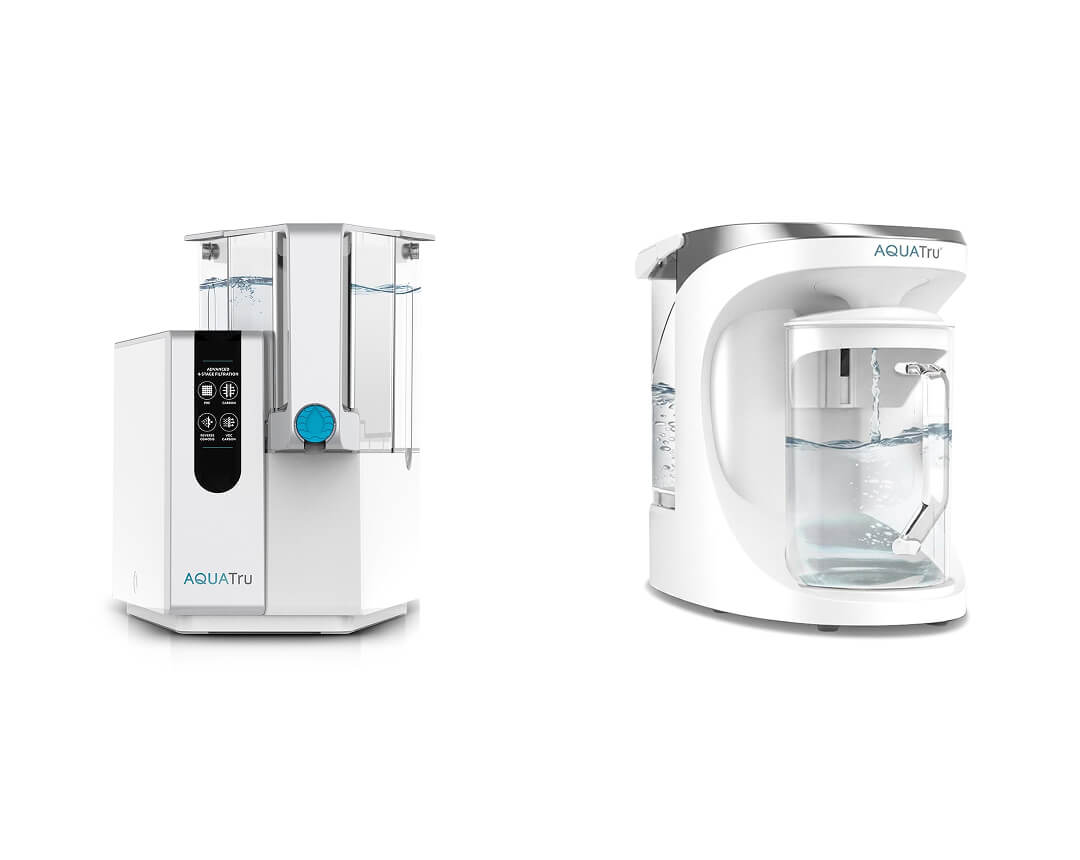
The AquaTru Carafe is a countertop reverse osmosis purifier that filters into a glass carafe rather than a plastic reservoir, in a body noticeably smaller than the Classic. It solves two specific objections to the original: the counter space it occupies, and the fact that purified water sits in plastic until you pour it.
What it does not do is filter more, faster, or more cheaply. The Carafe is the same technology in a different package, aimed at a smaller household — and it uses a cartridge platform that is not interchangeable with the full AquaTru range.
TapWater.org earns a commission on purchases made through links on this page.
The Short Version
Buy the Carafe if counter space or glass storage is what's stopping you, and if one or two people are drinking the output. Buy the Classic if you're filtering for three or more, or if you'd rather not refill a smaller tank as often.
The price gap runs in the Carafe's favor at the base of each range and closes as you move up the variants. That makes the Carafe the cheaper entry into certified countertop RO, which — combined with a product line that is genuinely new — is why demand for it has grown faster than for any other AquaTru model this year.
What It's Certified For — and Why You Won't Find It on NSF's Site
AquaTru's systems are certified to NSF/ANSI Standards 42, 53, 58, 401 and 372, and the Carafe carries that certification as a complete system rather than as individual components. The detail that confuses buyers is the certifier: AquaTru is certified by IAPMO R&T, not by NSF International.
Both are ANSI-accredited certification bodies, and a certification issued by IAPMO against an NSF/ANSI standard is a real, third-party-verified certification. But it means that searching NSF's certified products database for "AquaTru" returns nothing, which reasonably leads people to conclude the marketing is empty. It isn't. The listings live in IAPMO's product database at pld.iapmo.org, and that's where you verify them.
The five standards do different jobs, and knowing which is which is how you read the "84 contaminants" headline correctly:
- NSF/ANSI 42 — aesthetic effects. Chlorine taste and odor, particulates. Not health claims.
- NSF/ANSI 53 — health effects from the carbon stages. Lead, cysts, VOCs, chromium — and, on the Under Sink datasheet, PFOA/PFOS at 97.5% minimum reduction.
- NSF/ANSI 58 — the reverse osmosis system standard. TDS reduction plus, where listed, fluoride, arsenic (pentavalent only), nitrate/nitrite, uranium, chromium-6.
- NSF/ANSI 401 — emerging compounds. Pharmaceutical traces, pesticides, BPA.
- NSF/ANSI 372 — lead-free materials. A safety standard for the product itself, not a filtration claim.
AquaTru markets the range as reducing 84 contaminants — a figure that has appeared as 82, 83, 84 and 86+ across sources depending on year and model. It is the sum of certified claims across all five standards presented as one number. That's marketing framing, but it is not an inflated one — the underlying claims are individually listed. Independent reviewer WaterFilterGuru assesses AquaTru as certified for 100% of its reduction claims, which is a tighter claims-to-certification match than most of the countertop segment manages.
The practical takeaway: if you're buying for one specific contaminant, don't buy on the marketed count. Open the IAPMO listing for the exact SKU and confirm that contaminant is named. Arsenic in particular is certified as pentavalent arsenic only under NSF/ANSI 58 — a distinction that matters enormously on well water.

Carafe vs Classic: The Decision
The differences that actually change the answer are three.
Capacity. The Carafe's glass carafe holds less than the Classic's reservoir. For one or two people this is irrelevant; for a household of four it means refilling and waiting through more batches per day. Batch filtering is the fundamental countertop compromise, and a smaller batch amplifies it.
Storage material. The Carafe stores purified water in glass. The Classic stores it in BPA-free plastic. Whether that matters to you is a judgment call — BPA-free plastic in contact with cold water is not a documented exposure problem, and AquaTru holds NSF/ANSI 372 certification for materials on both. But it is the reason a meaningful share of Carafe buyers chose the Carafe, and it's a legitimate preference rather than a technical error.
Filters. They are not interchangeable. Carafe cartridges fit the Carafe; Classic cartridges fit the Classic, Classic Smart and Under Sink. Annual carbon replacement costs are the same on both platforms, so this doesn't change the running cost — it changes what you can order by accident. See our AquaTru filter replacement guide for the full cartridge map.
What is not different: filtration performance, certification scope, and the fact that both are batch systems requiring manual refill.
Who Should Skip It
If three or more people drink filtered water in your household, the Carafe will annoy you. Refill frequency is the complaint that turns into a return.
If you can install under-sink, do that instead. An under-sink RO system delivers on demand at the tap, holds broader certifications in some cases, and runs $50 to $90 a year in filters against AquaTru's roughly $130 on the datasheet's replacement schedule. The countertop form factor exists to serve people who cannot modify plumbing — renters, people in older buildings, anyone whose landlord conversation isn't worth having. If that constraint doesn't apply to you, you're paying a premium for a compromise you don't need.
One more check before buying: AquaTru's datasheet sets a hard water operating limit of 10 gpg (171 mg/L) — above it, scale plugs the membrane. The limit applies to the whole range, Carafe included; see which US cities sit above it and whether yours is one.
And if price is the binding constraint, certified countertop RO exists below AquaTru's range. Bluevua's RO100ROPOT and SimPure's Y7P-BW both sit well under the Carafe and both carry NSF/ANSI 58 certification. They rate lower on build and support in user reviews, and neither matches AquaTru's five-standard certification breadth — but "certified RO on the counter" is available for less, and it would be dishonest to pretend otherwise.
Price and Value
Across the Carafe range, the variants differ by two things: whether the stage-4 cartridge remineralizes (the Alkaline models), and whether the unit reports filter life to an app (the Smart models). Neither changes filtration.
The remineralization stage is worth the difference if you find RO water tastes flat — a common and legitimate reaction, since the membrane strips the minerals that give water flavor. The app connectivity is worth it if you would otherwise forget filter changes, and worth nothing if you set a calendar reminder. Both add cost without adding certified contaminant reduction.
Against bottled water the math is not close: a household spending $400 a year on bottled water covers a Carafe plus two years of filters in roughly the same period, with third-party-verified reduction claims that bottled water does not carry.

Frequently Asked Questions
Is the AquaTru Carafe NSF certified?
The AquaTru Carafe is certified to NSF/ANSI Standards 42, 53, 58, 401 and 372, but by IAPMO R&T rather than by NSF International. Both are ANSI-accredited certifiers, so the certification is legitimate third-party verification — it simply means the listing appears in IAPMO's database at pld.iapmo.org rather than NSF's.
Do AquaTru Carafe filters fit the Classic?
No. The Carafe uses a separate cartridge platform. Classic, Classic Smart and Under Sink models share a different one. Ordering across the two is the most common AquaTru purchasing mistake.
AquaTru Carafe or AquaTru Classic — which should I buy?
Choose the Carafe for one- or two-person households, tight counter space, or if you want purified water stored in glass. Choose the Classic for three or more people, where the larger reservoir means fewer refills. Filtration performance and certification scope are the same on both.
What does "removes 84 contaminants" actually mean?
It is the total of certified reduction claims across all five standards AquaTru is certified to. The claims are individually listed and independently verified, but if you are buying to address one specific contaminant, check that contaminant by name on the IAPMO listing for your exact model rather than relying on the headline number.
Does the AquaTru Carafe remove arsenic?
AquaTru's certification under NSF/ANSI 58 covers pentavalent arsenic. Trivalent arsenic — the form that dominates in anaerobic groundwater and therefore in many private wells — is not covered by that standard and requires pre-oxidation before any RO system will remove it effectively. Verify the specific claim on your model's IAPMO listing.
TapWater.org writes its contaminant and filtration guides from EPA SDWIS, USGS and municipal Consumer Confidence Report data, and reads certification claims from the certifiers' own published listings. About TapWater.org
TapWater.org aggregates publicly available data from EPA SDWIS, USGS and municipal CCRs, and reads certification claims from the certifiers' own published listings. We do not independently test water or filtration products.