
Best Arsenic Water Filters (2026): What Actually Removes It
By the TapWater.org Editorial Team
Most water filters sold in the United States do nothing at all for arsenic. Pitcher filters, faucet-mount units, refrigerator cartridges and whole-house carbon tanks all rely on activated carbon, and activated carbon does not remove dissolved arsenic. If your water tests positive for arsenic, the realistic options narrow to two: a reverse osmosis system certified for arsenic reduction, or a dedicated adsorption filter using activated alumina or iron oxide media.
That narrowing is what makes arsenic unusual. For most contaminants you can buy a decent carbon filter and improve your water meaningfully. For arsenic you either buy the right technology or you buy nothing, and there is very little middle ground. The health effects and regional distribution of arsenic are covered on our contaminant page; this guide is about removal.
TapWater.org earns a commission if you buy through links on this page. It doesn't change what we recommend — several of the systems below are ones we tell most readers to skip.
The Short Answer
An under-sink reverse osmosis system certified to NSF/ANSI 58 with an explicit pentavalent arsenic reduction claim is the right choice for the large majority of households with arsenic in their water. It treats the water you actually drink and cook with, costs $150–$500, and installs in under an hour without a plumber in most kitchens.
Two caveats decide whether that recommendation holds for you. First, the certification must name arsenic — a system certified to NSF/ANSI 58 for TDS reduction alone has not been tested for arsenic at all. Second, if your water contains arsenite rather than arsenate, reverse osmosis alone will underperform badly. Both points are covered below, because both are routinely omitted from filter roundups.
A side benefit of the same membrane: reverse osmosis also removes nitrate, fluoride, and chromium-6.
How We Sourced This
TapWater.org does not test water filters in a laboratory, and we don't claim to. This guide is built from three sources we can point you at directly: the NSF certified-products database, which lists the specific reduction claims each system was actually tested for; EPA's Best Available Technology determinations for arsenic under the Safe Drinking Water Act; and the arsenic concentrations published in municipal Consumer Confidence Reports, which we aggregate across US cities.
Where we make a performance claim about a product, it comes from its certification listing rather than from marketing copy. Where we make a claim about arsenic chemistry, it comes from EPA's own rulemaking documentation. Anything we could not verify, we have left out.
Why Most Filters Do Nothing for Arsenic
Activated carbon removes contaminants by adsorption — organic molecules stick to the enormous surface area inside the carbon granules. Dissolved inorganic arsenic does not stick. It passes straight through, which is why a Brita pitcher, a PUR faucet mount and a refrigerator filter all leave arsenic concentrations essentially unchanged.
Water softeners are equally ineffective, for a different reason: ion-exchange resin in a softener is charged for calcium and magnesium, not for arsenic species. And boiling actively makes the problem worse. Water evaporates, arsenic does not, so the concentration in the remaining water rises.
EPA lists only three point-of-use or point-of-entry technologies as Best Available Technology for arsenic: point-of-use reverse osmosis, point-of-use activated alumina, and point-of-entry activated alumina. Everything else — anion exchange cartridges, pour-through devices, distillation units — may work in specific circumstances but has not met EPA's evidentiary bar for compliance purposes.
The Certification Trap: "NSF 58 Certified" Is Not "Certified for Arsenic"
NSF/ANSI 58 is a system-level standard for point-of-use reverse osmosis, and it contains separate test protocols for separate claims. A manufacturer chooses which claims to certify. TDS reduction is the cheapest and most common. Pentavalent arsenic reduction is a distinct, additional claim that many otherwise-certified systems simply do not carry.
The practical consequence is that "NSF/ANSI 58 Certified" on a box tells you the system was tested against something in that standard. It does not tell you it was tested for arsenic. Two systems sitting next to each other on the same shelf, both displaying the same certification mark, can differ entirely on whether arsenic was ever measured.
There is a second layer to this. NSF/ANSI 58 is a whole-system certification. A membrane cartridge that is individually certified does not confer certification on the assembled unit it sits inside — a distinction manufacturers occasionally blur with phrasing like "built with NSF-certified components" or "tested to NSF standards."
How to check in ninety seconds: go to the NSF certified products database, search the exact model number, and read the reduction claims list on the listing. If the words "Arsenic (Pentavalent)" do not appear, the system has not been certified for arsenic, regardless of what the product page says. This one check eliminates more bad purchases than any spec comparison. One wrinkle: some manufacturers certify through IAPMO R&T — an equally ANSI-accredited certifier — instead of NSF International; those listings live at pld.iapmo.org, so a miss on nsf.org doesn't by itself mean a product is uncertified.

Arsenic III vs Arsenic V: The Failure Mode Nobody Warns You About
Arsenic exists in drinking water in two inorganic forms, and reverse osmosis handles them very differently. Arsenate — arsenic V — carries a negative charge at normal drinking water pH and is rejected efficiently by an RO membrane. Arsenite — arsenic III — is electrically neutral under the same conditions, so the membrane has far less to grip. EPA states the position plainly in the arsenic rule: removal efficiencies for As(V) are much better than for As(III) across every technology evaluated, and where As(III) is present, pre-oxidation to As(V) is necessary.
This matters because of where arsenic comes from. As(V) dominates in aerobic surface water. As(III) dominates in anaerobic groundwater — which is exactly the source most likely to contain arsenic in the first place. If you are on a private well drawing from a reducing aquifer, arsenite is the form you should assume is present until a lab tells you otherwise.
Every NSF/ANSI 58 arsenic certification is written for pentavalent arsenic. None of them certify arsenite reduction. A system that performs exactly as certified can still leave you well above 10 ppb if your water is arsenite-dominated.
The fix is pre-oxidation, which converts As(III) to As(V) before the water reaches the membrane. Free chlorine, potassium permanganate and ozone are all effective oxidants — AquaTru's own performance documentation states that a free chlorine residual rapidly converts trivalent arsenic to pentavalent, and that ozone and potassium permanganate do the same. Chlorinated municipal water often does this conversion for you incidentally. Untreated well water generally does not, so a well system usually needs a chlorination or oxidation stage ahead of the RO — and aeration, despite being the intuitive choice, was found ineffective for arsenite oxidation in EPA-cited field work.
The chloramine wrinkle: the same documentation warns that combined chlorine — chloramine — may not convert all trivalent arsenic. Many US utilities disinfect with chloramine rather than free chlorine, so city water is only the more forgiving case if your utility uses free chlorine. Your utility's Consumer Confidence Report states which one it uses — ask, or check your city's page — before assuming the conversion has been done for you.
The order of operations that follows from this: ask your lab for arsenic speciation, not just total arsenic. Most standard panels report total arsenic only. Speciation costs slightly more and determines whether an RO system alone will solve your problem or only half of it.

Arsenic in US City Water: Where This Actually Applies
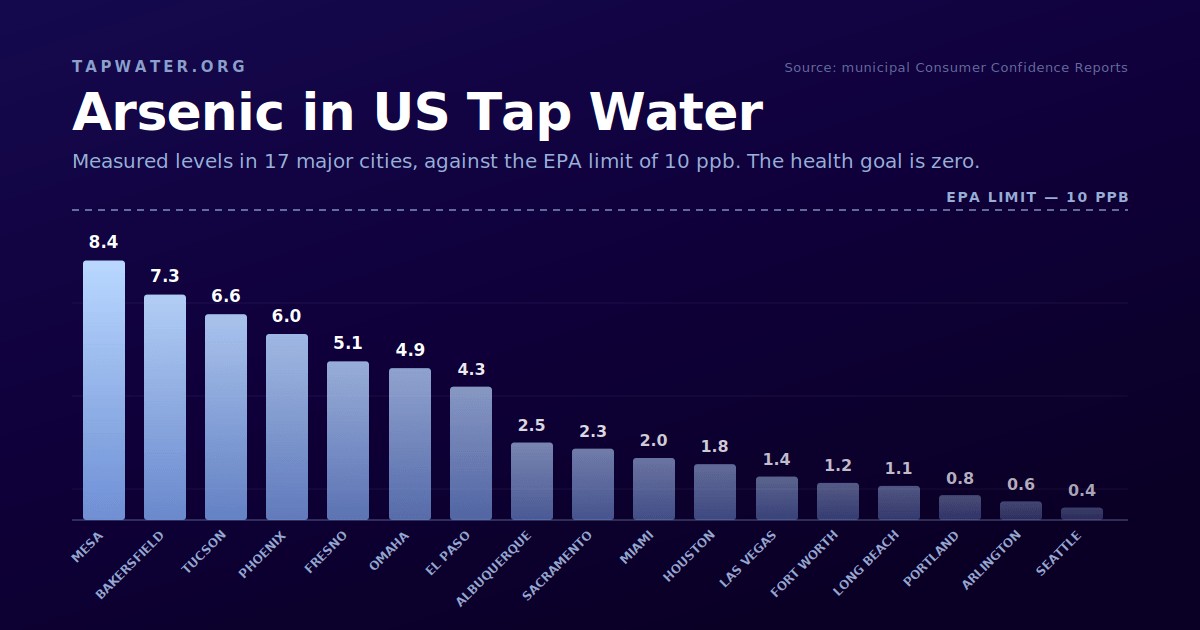
Reported arsenic in the 17 of 51 large city systems in our Consumer Confidence Report dataset that publish an arsenic value, vs. the EPA limit of 10 ppb
Municipal utilities are required to test for arsenic and publish results, and the spread across major US cities is wide. The values below come from the most recent Consumer Confidence Reports we have processed.
| City | Arsenic (ppb) | % of EPA limit | What we'd do |
|---|---|---|---|
| Mesa, AZ | 8.37 | 84% | Under-sink RO — margin to the limit is thin |
| Bakersfield, CA | 7.27 | 73% | Under-sink RO — margin to the limit is thin |
| Tucson, AZ | 6.64 | 66% | Under-sink RO — margin to the limit is thin |
| Phoenix, AZ | 6 | 60% | RO worth it with children or pregnancy in household |
| Fresno, CA | 5.12 | 51% | RO worth it with children or pregnancy in household |
| Omaha, NE | 4.9 | 49% | RO worth it with children or pregnancy in household |
| El Paso, TX | 4.3 | 43% | RO worth it with children or pregnancy in household |
| Albuquerque, NM | 2.5 | 25% | Optional |
| Sacramento, CA | 2.3 | 23% | Optional |
| Miami, FL | 2 | 20% | Optional |
| Houston, TX | 1.8 | 18% | Not indicated for arsenic |
| Las Vegas, NV | 1.4 | 14% | Not indicated for arsenic |
| Fort Worth, TX | 1.2 | 12% | Not indicated for arsenic |
| Long Beach, CA | 1.1 | 11% | Not indicated for arsenic |
| Portland, OR | 0.8 | 8% | Not indicated for arsenic |
| Arlington, TX | 0.6 | 6% | Not indicated for arsenic |
| Seattle, WA | 0.4 | 4% | Not indicated for arsenic |
Two things stand out. Southwestern cities drawing on groundwater cluster at the top — Mesa sits at 84% of the legal limit, meaning a modest seasonal shift could push it over. And Pacific Northwest surface-water systems sit near zero, which is why a filter marketed on arsenic removal is close to pointless in Seattle or Portland.
The limit itself deserves context. EPA's health goal for arsenic is zero, not 10 ppb, and California's Public Health Goal is 0.004 ppb — roughly 2,500 times stricter than the federal standard. "Within limits" and "safe" are further apart for arsenic than for almost any other regulated contaminant. You can look up your own city's arsenic value rather than reasoning from the table.

The Systems Worth Considering
Each entry below requires certification verification before purchase — see the check described above. Prices verified August 16, 2026; marketplace prices fluctuate.
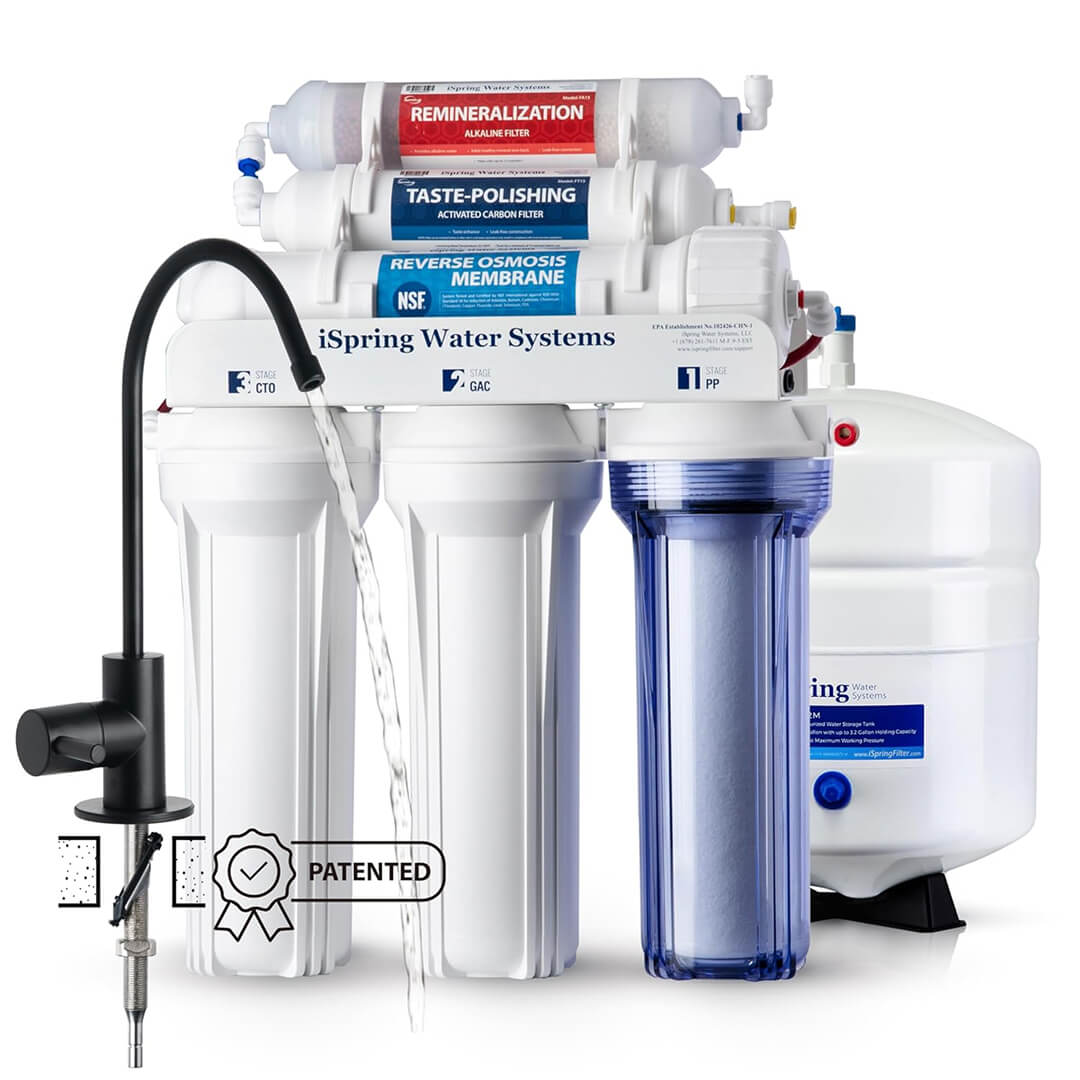
iSpring RCC7AK-BLK
$249.99The RCC7 platform is the value benchmark in certified under-sink RO, and the AK variants add an alkaline remineralization stage that puts minerals back after the membrane strips them, which addresses the flat taste that puts some people off RO entirely. A plain "RCC7AK" SKU no longer exists on Amazon — only finish variants — and the BLK variant states NSF/ANSI 58 certification explicitly on its listing, which makes it the one to buy for this use case (as always, confirm the arsenic claim itself on the NSF listing).
Installation is a genuine DIY job for anyone comfortable with a wrench, typically forty-five minutes to an hour, and filter replacements run roughly $50–$70 a year. The trade-off is the tank. It occupies meaningful space in a base cabinet, and it needs periodic sanitizing, which most owners skip and then wonder about taste.
Also available: RCC7AK-BN ($234.99, brushed nickel faucet) · RCC7AK-UVBN ($329.99, adds a UV stage)
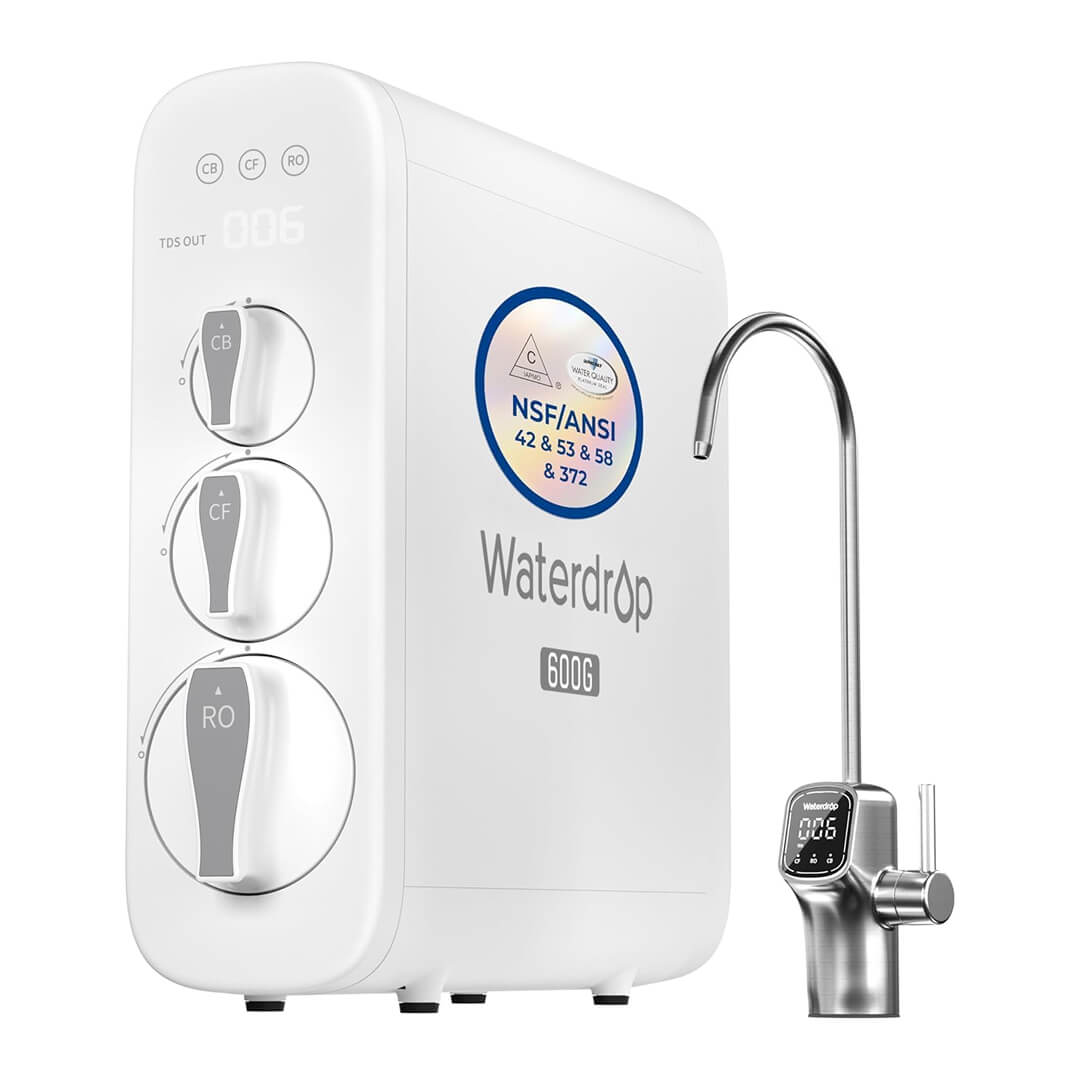
Waterdrop G3P600
$439The G3P600 is the volume seller in Waterdrop's tankless line, and the sensible pick: a materially lower price than the flagship G3P800 with the same certification scope. It is rated at 600 gallons per day through an 8-stage filter path — far more throughput than any household drinks — and being tankless it solves the cabinet-space problem and eliminates tank sanitizing. Its 2:1 pure-to-drain ratio wastes considerably less water than tank systems, a real consideration in the arid Southwestern states where arsenic is most common and water is metered aggressively. It requires an electrical outlet under the sink, which not every kitchen has.
At $439 it runs roughly 1.75 times the price of the iSpring, and the running costs deserve a look too: Waterdrop's annual filter replacements cost more than iSpring's, which adds up over a three-year horizon. Not a dealbreaker — but budget for both the sticker price and the cartridges.
Also available: G3P800 ($699, higher-output flagship)
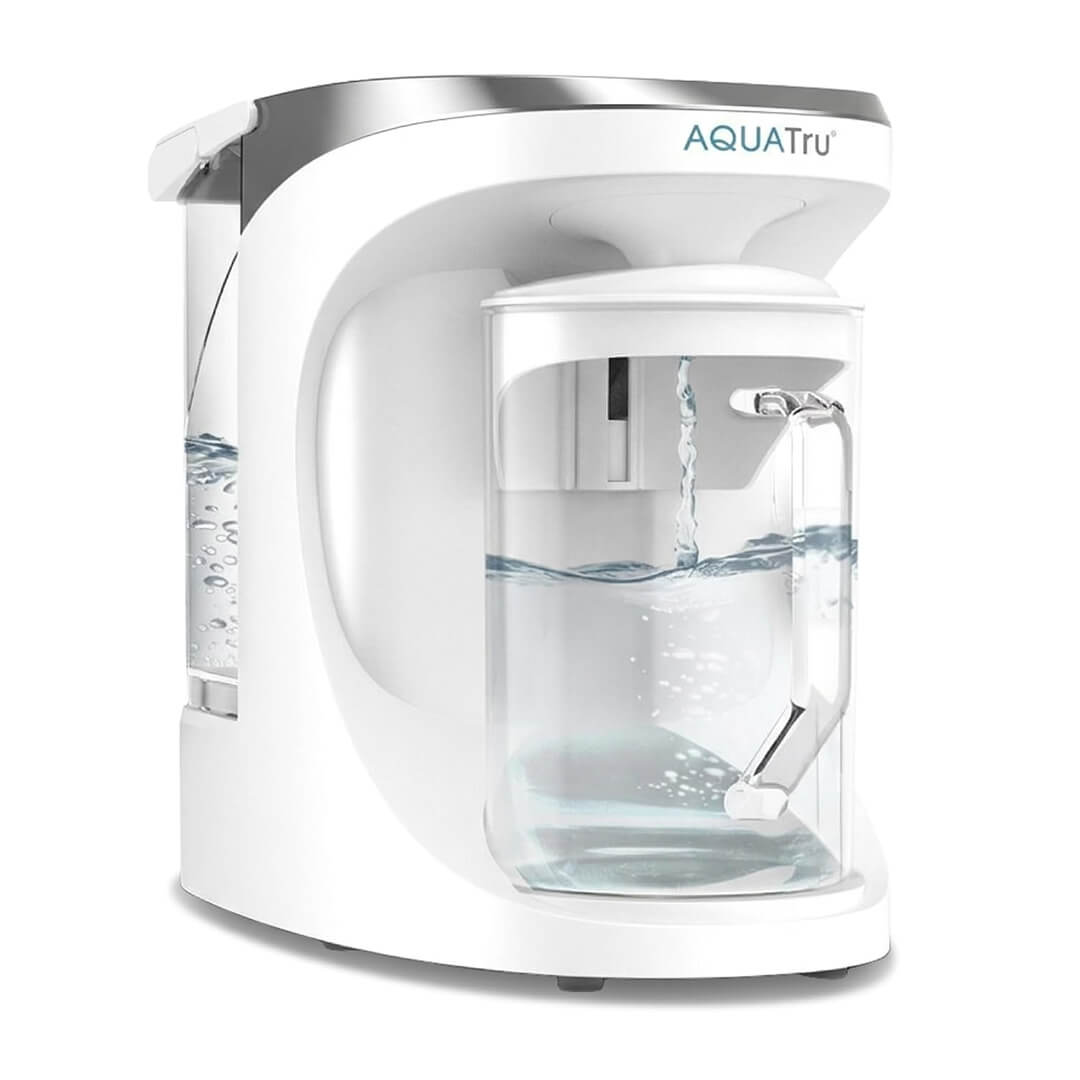
This section answers a different question than the ones above: not "what removes arsenic best" but "what can I do when drilling into the plumbing is off the table". On certification, the record is better than AquaTru's vague listing copy suggests: the systems are certified to NSF/ANSI 42, 53, 58, 401 and 372 — by IAPMO R&T, not NSF International, which is why searching NSF's database returns nothing. The listings live at pld.iapmo.org, and they are real third-party verification. For the Under Sink model ATU200, AquaTru's own Performance Data Sheet puts verified pentavalent arsenic reduction at 95.8% minimum and 98.0% average under NSF/ANSI 58 — figures verified for that model only; the Classic and Carafe datasheets are pending. The caveat that stands unchanged: NSF/ANSI 58 certifies pentavalent arsenic only — for AquaTru exactly as for every other RO system — so if arsenite is your problem, pre-oxidation still comes first. We've reviewed the full AquaTru range separately.
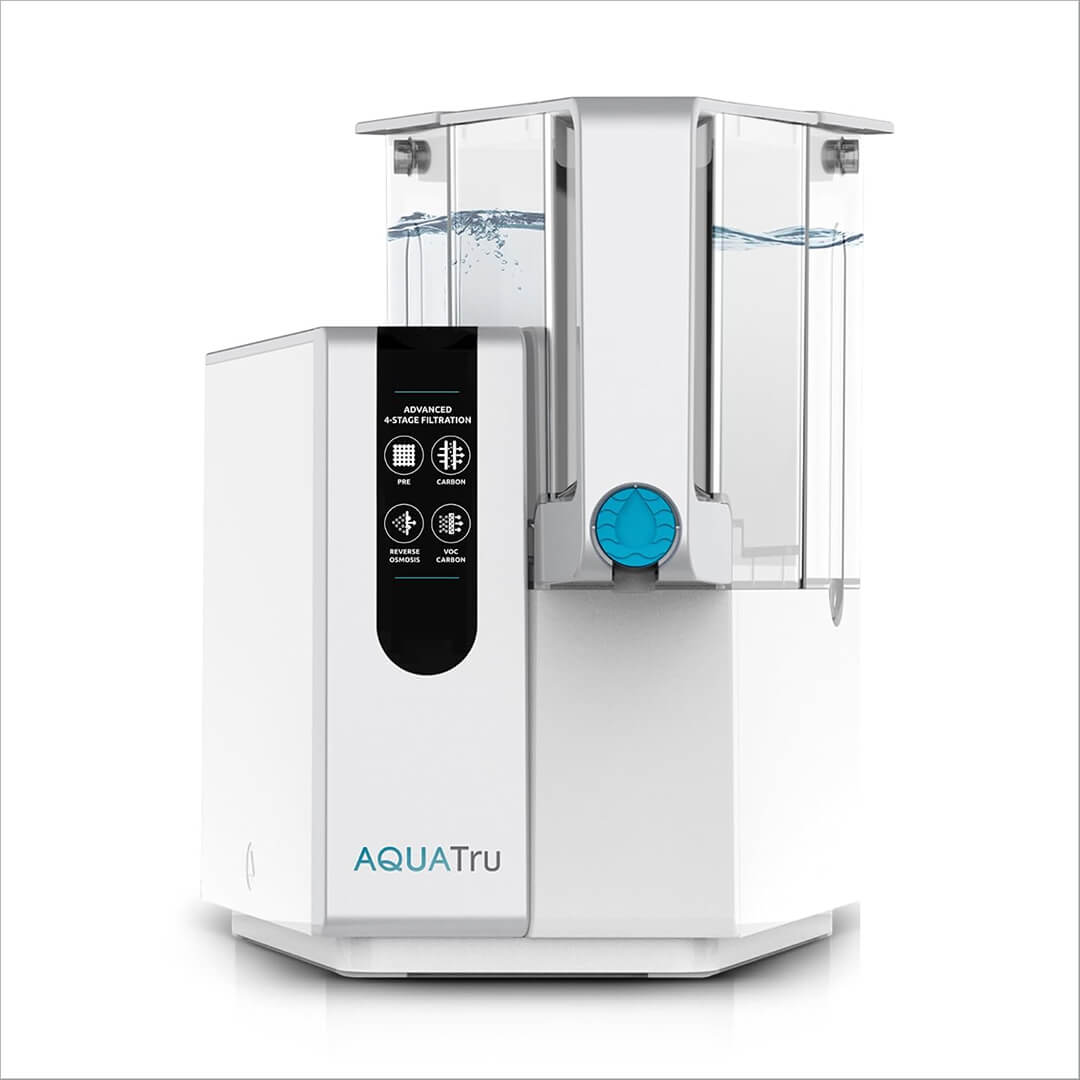
AquaTru Classic
$475The standard batch-fill countertop unit and the default choice in the line: fill the tank, it filters into a carafe, no plumbing, no drilling, no landlord conversation. It has the largest reservoir of the three, which matters more than it sounds — batch filtering means you wait for each refill. It's not for anyone who has cabinet access and wants on-demand water; an under-sink system is cheaper over three years once replacement filters are counted, and it takes up significant counter space.
AquaTru Glass Carafe
$375The cheaper, smaller sibling, with a glass carafe in place of plastic. That makes it the sensible pick for one- or two-person households and for anyone deliberately avoiding plastic contact with their drinking water. The trade is capacity: smaller batches, refilled more often. A family that empties the carafe twice at dinner will resent it.
AquaTru Under Sink
$395The same filter platform, plumbed in — for readers who want AquaTru's cartridges without losing counter space. Worth being clear-eyed about the logic, though: this model requires the same plumbing access as the under-sink systems above. If you can install this, you can install those, so it makes sense mainly if you're already committed to AquaTru's cartridge ecosystem.
One honest data point: AquaTru's Amazon ratings sit below the under-sink options — around 4.2 stars versus 4.5–4.6 for the iSpring and Waterdrop units. We haven't verified a consistent pattern behind the gap, so treat it as a signal to read recent reviews, not a verdict.
Quick Comparison
The four consumer systems side by side
| System | Price | Form factor | Installation | Annual filter cost | Pure-to-drain | Certification names arsenic |
|---|---|---|---|---|---|---|
| iSpring RCC7AK-BLK | $249.99 | Under-sink, tank | DIY, ~45–60 min | $50–$70 | Verify | Verify |
| Waterdrop G3P600 | $439 | Under-sink, tankless | DIY + outlet | Verify | 2:1 | Verify |
| AquaTru Classic | $475 | Countertop, batch-fill | None | Verify | Verify | Verify |
| AquaTru Glass Carafe | $375 | Countertop, batch-fill | None | Verify | Verify | Verify |
"Verify" = pending a manual check against the current listing or the NSF certified-products database — we don't fill in what we haven't confirmed. Prices verified August 16, 2026.
EPA lists activated alumina as Best Available Technology for arsenic at both point-of-use and point-of-entry, and iron-based adsorptive media perform well against both arsenic forms. These are the right architecture when you need whole-house treatment or when arsenite is confirmed and pre-oxidation is impractical.
Expect $1,000 and up, professional installation, periodic media replacement, and a water chemistry assessment first — sulfate, silica and pH all affect adsorption capacity. This is not an Amazon purchase, and anyone selling it to you as one is overselling.
Who Should Not Buy an Arsenic Filter
If your utility reports arsenic below roughly 2 ppb, an arsenic-specific filter solves a problem you don't have. Seattle, Portland, Fort Worth and Long Beach all sit in that band. A carbon filter for taste and chlorine byproducts is a more sensible purchase.
If you have not tested, do not buy yet. Arsenic is invisible, tasteless and odorless, and buying an RO system on suspicion is guesswork. Public water customers can read the utility's published value; private well owners need a lab test, and standard home test strips are not accurate at the concentrations that matter — a lab kit using EPA Method 200.8 detects down to 1 ppb. Our water test kit guide and well water test kit guide cover the options.
And if your concern is showering or bathing, you don't need arsenic treatment at all. Arsenic is not absorbed through skin in meaningful amounts during normal bathing at levels below 500 ppb. The exposure route is ingestion — drinking and cooking — which is precisely why point-of-use treatment at the kitchen tap is the correct architecture and a whole-house system is usually overspending.
Frequently Asked Questions
Does reverse osmosis remove arsenic?
Reverse osmosis removes pentavalent arsenic (arsenic V) efficiently, typically 90–95%, and is listed by EPA as Best Available Technology for arsenic at point of use. It removes trivalent arsenic (arsenic III) far less effectively, because arsenite is electrically neutral at normal drinking water pH and the membrane has less to reject. Where arsenite is present, pre-oxidation to arsenate is required first.
Does a Brita filter remove arsenic?
No. Brita pitchers use activated carbon, which does not adsorb dissolved inorganic arsenic. The same limitation applies to faucet-mount filters, refrigerator cartridges and whole-house carbon tanks. Arsenic removal requires reverse osmosis or a dedicated adsorptive medium such as activated alumina or iron oxide.
Does boiling water remove arsenic?
No — boiling concentrates it. Water evaporates and arsenic remains, so the concentration in the remaining water increases.
Is NSF/ANSI 53 or NSF/ANSI 58 the right certification for arsenic?
NSF/ANSI 58 is the standard that contains an explicit pentavalent arsenic reduction test protocol for reverse osmosis systems. Some NSF/ANSI 53 filters carry an arsenic V claim, but it is uncommon and must be verified on the individual listing rather than assumed. In both cases the certification is claim-specific: check that the listing names arsenic.
Do I need a whole-house arsenic filter?
Usually not. Arsenic exposure comes from ingestion, and bathing in water below 500 ppb carries no meaningful skin absorption risk. A point-of-use system at the kitchen tap treats the water that matters at a fraction of the cost. Whole-house arsenic treatment makes sense mainly for very high well concentrations or where multiple taps are used for drinking.
What arsenic level requires a filter?
The EPA limit is 10 ppb, but EPA's own health goal is zero and California's Public Health Goal is 0.004 ppb. Above 10 ppb, treatment is urgent. Between roughly 5 and 10 ppb, filtration is a reasonable precaution and we'd consider it necessary with children or a pregnancy in the household. Below about 2 ppb, an arsenic-specific filter isn't indicated.
The TapWater.org Editorial Team writes the site's contaminant and filtration guides, working from EPA SDWIS, USGS and municipal Consumer Confidence Report data. About TapWater.org
TapWater.org aggregates publicly available data from EPA SDWIS, USGS and municipal CCRs. We do not independently test water or filtration products. Our assessments reflect published certification records and EPA determinations, and are not health or medical advice.