
AquaTru Water Filter Review: Which Model Actually Makes Sense
By TapWater.org
AquaTru sells nine variants of what is essentially one product. All of them are four-stage reverse osmosis systems certified to the same five standards; the differences between them are form factor, whether minerals are added back after filtration, and whether the machine talks to an app. None of the differences change what comes out of the tap.
That makes the buying decision simpler than the product page suggests, and it makes most of the price ladder optional. The three questions that actually decide it: countertop or under-sink, how many people are drinking, and whether flat-tasting water bothers you.
TapWater.org earns a commission on purchases made through links on this page. It doesn't change the recommendations — the cheapest model in the range is the one most readers should buy.
How We Sourced This
TapWater.org does not test water filters in a laboratory. This review is built from three things we can point you at: the certification listings published by IAPMO R&T, which state exactly which contaminants each system was tested to reduce; publicly listed retail pricing and customer rating data; and the NSF/ANSI standards themselves, which define what each certification does and does not cover.
Where we describe what a model is certified for, that comes from the certifier's listing rather than from the brand's marketing. Where we make a claim about how the technology behaves, it comes from EPA's treatment technology determinations. Anything we could not verify is not in this article.
The Certification Question, Answered Properly
AquaTru is certified to NSF/ANSI Standards 42, 53, 58, 401 and 372 — by IAPMO R&T, not by NSF International.
This one sentence resolves most of the confusion around the brand. Searching NSF's certified products database for AquaTru returns nothing, which has led a lot of people to conclude the certification claims are hollow. They aren't. IAPMO R&T is an ANSI-accredited certification body, and a certification it issues against an NSF/ANSI standard carries the same weight. The listings simply live in IAPMO's database at pld.iapmo.org.
It also explains why AquaTru's Amazon listings say "Certified to NSF/ANSI Standards" rather than naming a certifier — and why that vaguer phrasing, which normally signals a weak claim, doesn't here.
| Standard | What it certifies | Health claim? |
|---|---|---|
| NSF/ANSI 42 | Chlorine taste and odor, particulates | No — aesthetic |
| NSF/ANSI 53 | Lead, cysts, VOCs, chromium via carbon stages | Yes |
| NSF/ANSI 58 | RO system performance: TDS, and where listed fluoride, pentavalent arsenic, nitrate, chromium-6 | Yes |
| NSF/ANSI 401 | Emerging compounds — pharmaceuticals, pesticides, BPA | Yes |
| NSF/ANSI 372 | Lead-free materials in the product itself | Product safety, not filtration |
AquaTru markets the system as reducing 84 contaminants — a figure that has appeared as 82, 83, 84 and 86+ across sources depending on year and model, so treat it as the brand's summary rather than a fixed spec. It is the sum of certified claims across all five standards. That's aggressive framing of a real number rather than an invented one — independent reviewer WaterFilterGuru rates AquaTru as certified for 100% of its stated reduction claims, which is a tighter match between marketing and certification than most of the countertop RO segment achieves.
Verified reduction claims (Under Sink model ATU200)
From AquaTru's own Performance Data Sheet (rev 06.26.R2), certified by IAPMO R&T under NSF/ANSI 58. These figures are verified for the Under Sink model ATU200 only — the Classic and Carafe have their own datasheets, which may differ.
| Substance | Minimum | Average |
|---|---|---|
| Arsenic (pentavalent) | 95.8% | 98.0% |
| Lead | 97.5% | 99.1% |
| Fluoride | 91.8% | 93.5% |
| Hexavalent Chromium | 94.3% | 97.2% |
| Trivalent Chromium | 92.3% | 98.0% |
| Uranium | 98.9% | 99.0% |
| Nitrate (as N) | 76.1% | 84.3% |
| Nitrite (as N) | 86.7% | 95.4% |
| Nitrate plus Nitrite (both as N) | 77.6% | 85.5% |
| Selenium | 95.7% | 98.1% |
| Barium | 88.0% | 96.4% |
| Copper | 90.6% | 95.2% |
| Radium 226/228 | 88.0% | 96.4% |
| TDS | 75.7% | 87.1% |
| Cyst | 99.9% | 99.9% |
Two claims live under other standards on the same datasheet: PFOA/PFOS is certified under NSF/ANSI 53 at 97.5% minimum reduction, and microplastics (particles 0.5 to <1 µm) at 96.48% average appear under both NSF/ANSI 42 and 401. Worth noting because almost no coverage of the brand surfaces them: uranium (98.9% minimum) and nitrate/nitrite are certified claims too.
The caveat that matters if you're buying for a specific problem: certification is claim-specific and SKU-specific. If you need arsenic removal, "84 contaminants" is not the answer — open the IAPMO listing for your exact model and confirm arsenic is named. And note that NSF/ANSI 58 certifies pentavalent arsenic only; the trivalent form common in groundwater requires pre-oxidation first, which is the failure mode that catches well owners out.

The Range, and What Actually Differs
Across all nine variants there are exactly three real differences.
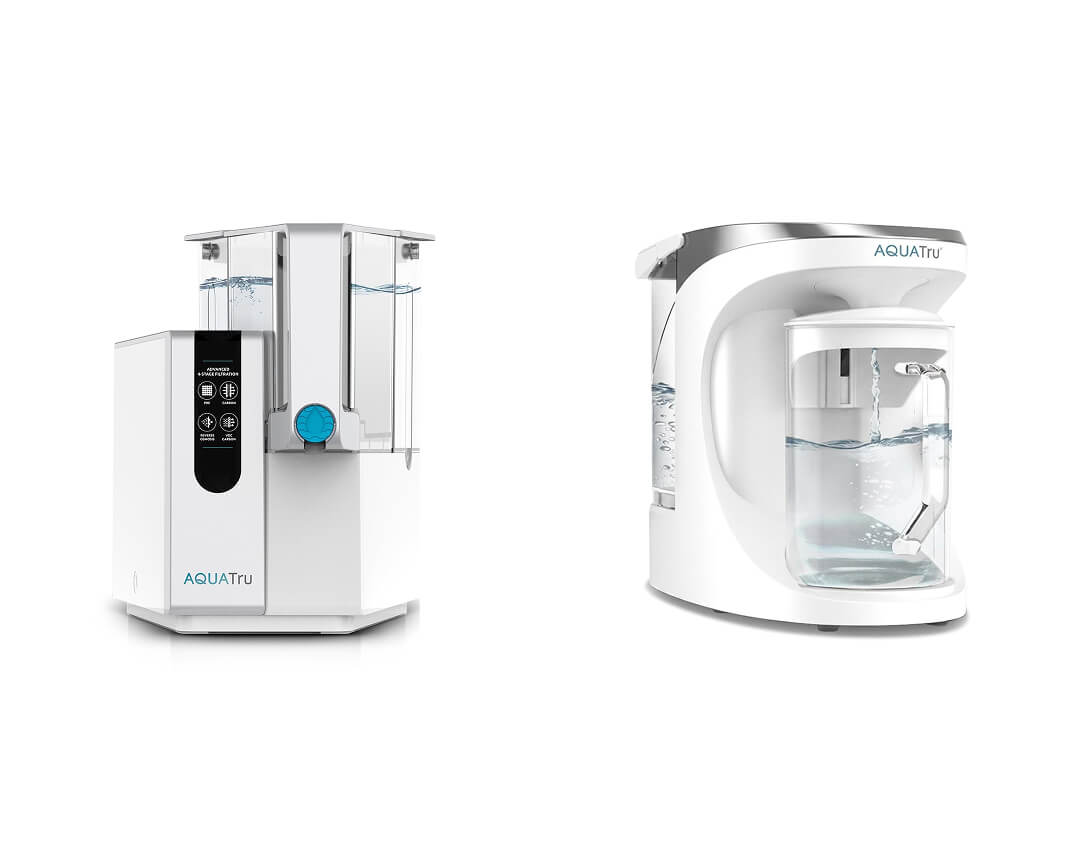
Form factor — countertop Classic, countertop Carafe, or under-sink. This is the only difference that changes daily experience.
Alkaline or not — whether the stage-4 cartridge remineralizes the water after the membrane strips it. RO water tastes flat to a lot of people, and this fixes that. It adds no certified contaminant reduction.
Smart or not — whether the unit reports filter life to a phone app. It adds nothing a calendar reminder doesn't.
Everything else is the same machine.
| Model | Form factor | Price | Rating |
|---|---|---|---|
| AquaTru Glass Carafe | Countertop, glass | $375 | 4.2 (698) |
| AquaTru Under Sink | Under-sink | $395 | — |
| AquaTru Glass Carafe Alkaline | Countertop, glass | $395 | 4.3 (236) |
| AquaTru Glass Carafe Smart | Countertop, glass | $425 | 4.4 (69) |
| AquaTru Glass Carafe Smart Alkaline | Countertop, glass | $445 | 4.4 (71) |
| AquaTru Classic | Countertop | $475 | 4.2 (1,000) |
| AquaTru Classic Alkaline | Countertop | $495 | 4.4 (69) |
| AquaTru Classic Smart | Countertop | $525 | 3.9 (12) |
| AquaTru Classic Smart Alkaline | Countertop | $545 | 4.7 (19) |
Prices as of August 2026. Ratings from publicly listed customer reviews; low review counts on newer variants make those figures unreliable.
Which One to Buy
Most people: the Glass Carafe. It is the cheapest way into the range, stores water in glass, and takes the least counter space. If one or two people are drinking the filtered water, nothing above it in the price ladder does anything more. Full detail in our AquaTru Carafe review.
Households of three or more: the Classic. The larger reservoir means fewer refill-and-wait cycles, which is the thing that turns countertop RO from convenient to irritating at volume.
If you can plumb it in: the Under Sink. It's cheaper than the Classic, uses the same cartridges, and delivers on demand rather than in batches. The only reason not to is that you can't drill a faucet hole or don't want to.
Add alkaline if: you've drunk RO water before and found it flat. Skip it otherwise — you can always buy the remineralizing stage-4 cartridge later, since it's the same slot.
Add smart if: never, unless the app genuinely solves a problem for you. It's $50 for a notification.
The Hardness Limit Nobody Mentions
From AquaTru's own Performance Data Sheet — checked against the hardness values in our city dataset
Buried in the datasheet is an operating limit that appears in none of the third-party coverage: above 10 grains per gallon (171 mg/L) hardness, limescale builds rapidly on the RO membrane, plugs the cartridge and renders the system ineffective. AquaTru does not recommend use above this hardness unless the water is softened beforehand. That is the manufacturer's own stated limit, not our opinion.
Checked against the 51 large city systems in our Consumer Confidence Report dataset, 12 cities sit at or above that limit. If you live in one of them, the honest answer is that an AquaTru needs a softener upstream — or isn't the right purchase.
| City | Hardness (mg/L) | Hardness (gpg) |
|---|---|---|
| San Jose, CA | 364 | 21.3 |
| San Antonio, TX | 308 | 18 |
| Indianapolis, IN | 292 | 17.1 |
| Las Vegas, NV | 291 | 17 |
| Jacksonville, FL | 260 | 15.2 |
| Phoenix, AZ | 251 | 14.7 |
| Mesa, AZ | 247 | 14.4 |
| San Diego, CA | 225 | 13.2 |
| Tucson, AZ | 211 | 12.3 |
| Tampa, FL | 185 | 10.8 |
| El Paso, TX | 175 | 10.2 |
| Omaha, NE | 171 | 10 |
AquaTru's limit: 171 mg/L = 10 gpg (hardness as CaCO₃). 2024 Consumer Confidence Report values; look up your own city if it isn't listed.
The other inlet limits on the datasheet
TDS max 1,500 mg/L · iron, manganese and sulfide below 0.1 mg/L · chlorine below 2 ppm · pH 3–11 · operating pressure 40–85 psi · recovery 50% · efficiency 25%
Who Should Buy Something Else
Anyone who can install under-sink RO and isn't wedded to the brand. An iSpring or Waterdrop under-sink system runs $250 to $450 against AquaTru's $375 to $545, and annual filter costs of $50 to $90 against AquaTru's roughly $130 on the datasheet's replacement schedule. Over three years that gap is real money. AquaTru's advantage is certification breadth — five standards against the two or three most competitors carry — and if that breadth is what you're buying, it's a defensible premium. If you just want TDS and lead down, you're overpaying.
Anyone on a strict budget who still wants certified countertop RO. Bluevua's RO100ROPOT and SimPure's Y7P-BW both sit well below AquaTru and both carry NSF/ANSI 58 certification. They score lower on build quality and support in user reviews, and neither approaches the five-standard breadth — but the core RO certification is there.
Anyone whose problem is hardness, not contaminants. RO will remove hardness minerals from your drinking water and do nothing whatsoever about scale in your pipes, shower or appliances. That's a water softener question, not a filter question.
Anyone who hasn't tested their water. Buying a $475 purifier on the basis of a general unease about tap water is buying without a target. Look up your city's published contaminant data first — it takes a minute, it's free, and for a meaningful number of US municipal systems the honest answer is that a $40 carbon pitcher would address everything actually present. If you'd rather test at your own tap, start with our water test kit guide.
Ownership Costs
Budget roughly $130 a year in filters on AquaTru's own replacement schedule. The datasheet rates the pre/carbon cartridge at six months — not the twelve most coverage assumes — which puts carbon costs at about $100 a year, rising to about $160 in the years the reverse osmosis membrane comes due. Our filter replacement guide breaks down which cartridge fits which model and where the combo packs are and aren't worth it.
Two ownership notes that show up repeatedly in customer reviews. Batch filtering means waiting — this is inherent to countertop RO, not an AquaTru flaw, but it surprises people moving from a pitcher. And RO systems send some water to drain; that ratio is a real consideration in metered arid regions, and it's one place where under-sink tankless systems have improved faster than countertop units.
Frequently Asked Questions
Is AquaTru NSF certified?
AquaTru is certified to NSF/ANSI Standards 42, 53, 58, 401 and 372 — by IAPMO R&T rather than NSF International. Both are ANSI-accredited certification bodies, so the certification is genuine third-party verification. Because the certifier is IAPMO, the listings appear at pld.iapmo.org rather than in NSF's database, which is why searching NSF's site for AquaTru returns nothing.
Which AquaTru model should I buy?
The Glass Carafe for one or two people, the Classic for three or more, and the Under Sink if you can plumb it in. All models filter identically; the differences are form factor, whether minerals are added back, and app connectivity.
Is AquaTru worth the price?
Its certification breadth — five NSF/ANSI standards — is wider than most of the countertop segment, and independent assessment rates it as certified for 100% of its claims. Against an under-sink RO system it costs more upfront and roughly $40 to $80 more per year in filters on the datasheet's replacement schedule. If you can install under-sink and don't need the certification breadth, cheaper options do the core job.
Does AquaTru remove fluoride and arsenic?
Both appear among AquaTru's certified claims under NSF/ANSI 58. Arsenic is certified as pentavalent arsenic only — the trivalent form common in groundwater needs pre-oxidation before any RO system removes it efficiently. Verify the specific claims on the IAPMO listing for your exact model.
What is the difference between AquaTru Classic and AquaTru Carafe?
Capacity and storage material. The Classic has a larger reservoir and stores in BPA-free plastic; the Carafe holds less and stores in glass, in a smaller body. Filtration and certification are identical. Their filter cartridges are not interchangeable.
How much do AquaTru filters cost per year?
On the datasheet's replacement schedule — pre/carbon every six months, VOC annually, membrane every two years — about $100 in carbon-only years and about $160 when the membrane is also due, roughly $130 annually on average.
TapWater.org writes its contaminant and filtration guides from EPA SDWIS, USGS and municipal Consumer Confidence Report data, and reads certification claims from the certifiers' own published listings. About TapWater.org
TapWater.org aggregates publicly available data from EPA SDWIS, USGS and municipal CCRs, and reads certification claims from the certifiers' own published listings. We do not independently test water or filtration products. Our assessments are not health or medical advice.